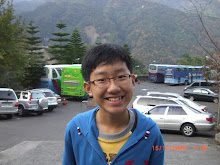
This is a poem on my primary school days:
Everyday when I step into my school
I can see students pushing their way through
With nurses standing by the side
To attend to their needs
Everyday when I step into my classroom
My teacher will shout at the top of his lungs
With the students covering their ears
The naughty ones will think of it as a choir song
While the sleepy ones will think of it as a wake-up call
Everyday when I step into the toilet
Brown solids will be all around you
A smell worse than a garbage dump
Will travel right up to your nose
Everyday when I step into the canteen
Students as fat as a hippopotamus
Will eat as if they have not eaten for a decade
And end up becoming a hot air balloon
Everyday when I step out of school
A wide grin would be stretched across my face
My heart starts thumping
School is finally over
On Monday, May 24, 2010


On
The poet felt that his school days were unpleasant ones as there were 'black crows' that interrupted him when singing the National Anthem. This states that the school is not very peaceful and quiet in the mornings but rather noisy because of the chirping of the 'black crows'. His shoes are very 'difficult to maintain' its whiteness which means that the school's environment is not very clean and thus, his shoes are often dirty. The fact that the poet mentions 'Seven to the power of five is unreasonable' shows that the poet felt that the school's mathematics is too difficult for him to work out. He is also not clever in the way that he is not able to solve the 'Seven to the power of five' question. 'The capital of Singapore is Singapore' means the poet thinks that Singapore is so small and tiny that it does not even have a capital to the extent that its capital is still 'Singapore'. His friend 'Shaded all A's' for the multiple choice of the Chinese test gives the poet an impression that his friend does not take the test seriously and thus, uses 'a heroic thing' to further exaggerate this incident. A photo was taken when the poet's eyes were closed shows how much he hates the school for taking such an ugly photo of him. Thus, his school days were overall unpleasant ones with very little good days.
On Wednesday, May 19, 2010
Children in India began working at a very young and tender age. Many children have to work to support their families and some families even expect their children to continue the family business at a young age. India has always thought of ways to tackle and eliminate child labour in India. Fortunately, compulsory universal elementary education and labour protection are secured for the children.
Now, let us take a look at the Human Rights, India’s government and my perspectives on child labour in India:
Human Rights:
The Human Rights has agreed to protect the children from child labour. They think the child labour is a serious offence and are concerned about the rights to life survival and development of the child. They think that children should not work at such a young age and ensure the survival and development of the child to the maximum possible extent. They will enable the children to have opportunities and facilities to lead a healthy life style, and protect them against child labour. They have provisions to recognise that the child has the right not to perform any work which is likely to harm the child’s development. They decided to provide free and compulsory education for children up to the age of fourteen. They will try their best to do anything to prevent child labour from taking place.
India's Government:
The India’s government thinks that child labour talks more of regulation than prohibition of child labour. The government feels that child labour can never be eliminated and that certain forms of child labour are inevitable, it is even less likely to serve any purpose. Thus, the government refuses to provide any solutions to prevent child labour. They do not even care to modify its approach and change the policies. They are pessimistic to the problem on child labour. They think that children are supposed to work at such a young age to earn profits, which are essential to the family. They do not seem to have pity for the child labourers. No action is taken by the government to prevent child labour from happening.
Me:
I am deeply impressed by the Human Rights actions and optimistic reactions to child labour. I believe that once measures are taken to protect the children form child labour, the cases of child labour will surely decrease. What the Human Rights is doing is good, as they are at least trying their very best to prevent child labour. If I were them, I would do the same, unlike India’s government, who are pessimistic, thinking that child labour can never be eliminated and did nothing to help child labourers. We have to give it our all not to let child labourers suffer. I will think of ways and methods to prevent child labour. We have to put ourselves into the children’s shoes. If you are working at such a young age, would you like it? Would you love to be working everyday under the hot sun? The answer is definitely no. So, why not give a helping hand and help the child labourers? If we keep trying to overcome the odds of child labour, the cases of child labour will decrease and eventually, it will be eliminated.
Similarities between Child Labour and Village by the Sea
Similarities:
1. Poverty in the family
2. Children working at a young age
3. Children have to start work early in the morning
4. Children lack of education
5. Families lack of food
5. Families lack of food
6. Families lack of medical care
7. Children have to support family
Subscribe to:
Posts (Atom)
.jpg)